In 1976, Rosemary Nicholson peered through the boarded-up windows of a derelict church on Lambeth Palace Road and saw not ruin, but possibility. That act of observation would rescue St Mary-at-Lambeth from demolition and transform it into the Garden Museum: Britain's only museum dedicated to the art, history and design of gardens.
A Church Older Than the Borough
The church Nicholson found was no ordinary Victorian parish structure. St Mary-at-Lambeth stands as the oldest building in the London Borough of Lambeth, with the exception of the crypt beneath Lambeth Palace itself. The first church on this site was built around 1062 by Goda, sister of Edward the Confessor, and was recorded in the Domesday Book of 1086. That wooden structure was later rebuilt in stone, and the medieval tower that rises above the museum today dates to 1377. It has survived almost unchanged for more than six centuries.
The building served as a parish church for centuries, functioning as what historians describe as an "annex to Lambeth Palace" given its proximity to the Archbishops of Canterbury's London residence. Among those buried in the churchyard are John Tradescant the Elder and his son, the 17th-century royal gardeners and plant hunters whose tomb would prove pivotal to the building's later fate. Also interred here is Elizabeth Boleyn, mother of Anne Boleyn, alongside generations of archbishops and local parishioners.
By the mid-20th century, the church had fallen into disrepair. The stained glass was damaged during the Second World War, and the Victorian altar donated by Sir Henry Doulton in 1888 was destroyed. The parish was deconsecrated in 1972 as the local population shifted and the building deteriorated. When Nicholson visited in 1976, the church was sealed and awaiting demolition.
The Rescue Mission
What Nicholson discovered behind those boards was the tomb of the Tradescants, the father-and-son gardeners who served Charles I and collected specimens from around the world. Their "Ark" was one of England's first museums, and their final resting place inspired Nicholson to act. She established the Tradescant Trust and secured a 99-year lease from the Diocese of Southwark, saving the structure from demolition.
The Museum of Garden History opened to the public in 1977, becoming the first museum in the world dedicated to the history of gardening. For over three decades, it operated from the restored church building, displaying tools, art and ephemera of British horticulture while maintaining the sacred character of the deconsecrated space.
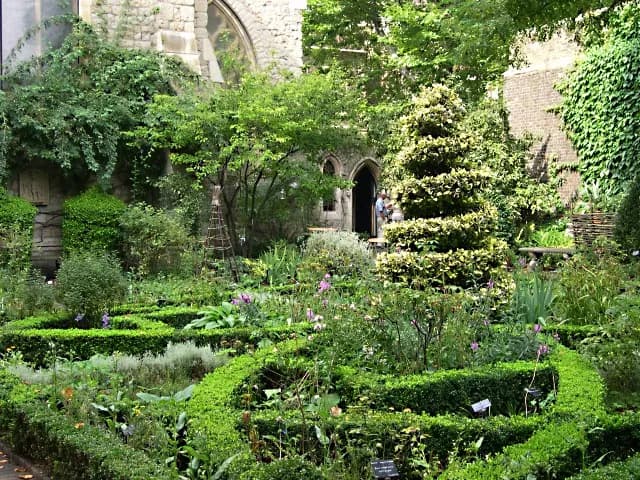
The museum was renamed the Garden Museum in 2008, broadening its scope while maintaining its intimate connection to the building and its surroundings. A recreation of a 17th-century knot garden was established in the former churchyard, designed to reflect the kind of formal garden the Tradescants might have known.
Rediscovery and Renewal
In April 2016, builders working on a major redevelopment project made an extraordinary discovery. Beneath the church floor, a hidden crypt contained 30 lead coffins, including the remains of five Archbishops of Canterbury: Richard Bancroft, who oversaw the King James Bible; John Moore; Frederick Cornwallis; Matthew Hutton; and Thomas Tenison. The find confirmed the building's status as one of the most historically significant structures in the borough.
The £7.5 million redevelopment completed in 2017 addressed the practical challenge of expanding exhibition space while preserving the medieval fabric. The solution employed Swiss prefabricated timber technology that stands without foundations, allowing the building to be doubled in size without compromising its structural integrity. The project included new gardens designed by Dan Pearson and Christopher Bradley-Hole, as well as a glass floor panel above the archbishops' vault allowing visitors to glimpse the coffins below.
The museum now houses Britain's only dedicated collection of garden history, with galleries on the first floor occupying the body of the church. Exhibitions rotate every six months, covering everything from Derek Jarman's garden to the work of botanical artists. The Tradescant's Ark gallery recreates the 17th-century cabinet of curiosities, displaying objects on loan from the Ashmolean Museum. In 2019, the Archive of Garden Design opened, providing access to the personal papers of leading British garden designers including Penelope Hobhouse, Beth Chatto and Alan Titchmarsh.
The museum continues to evolve. In 2021, the Pinchbeck Charitable Trust gifted Benton End, the Suffolk home of artist Sir Cedric Morris and his partner Arthur Lett-Haines, to the museum. The walled garden there has been restored and opened to visitors, extending the museum's reach beyond Lambeth while maintaining its focus on horticultural heritage.
Connection to the Community
The Garden Museum operates as an independent registered charity, number 1088221, without government funding. Its "Neighbours" programme offers free entry to Lambeth community organisations, maintaining the building's role as a civic resource. The museum also manages the Lambeth Green project, working with Transport for London and Lambeth Council to transform 5.3 acres of land near the museum into improved public space.
The building remains a working museum, not a monument. Visitors can climb the 1377 tower for views over the Thames, attend talks in the nave, or browse the collection of 16th and 17th-century gardening tools. The parish burial records document an estimated 26,000 burials on the site, a reminder that this was once a working church serving riverside Lambeth for nearly a millennium.
From a wooden chapel built by a Saxon princess to a Victorian reconstruction, from deconsecration to near-demolition to international recognition, St Mary-at-Lambeth has undergone constant reinvention. The Garden Museum represents its latest chapter: a sanctuary not for souls but for the history of how humans cultivate and shape the natural world.