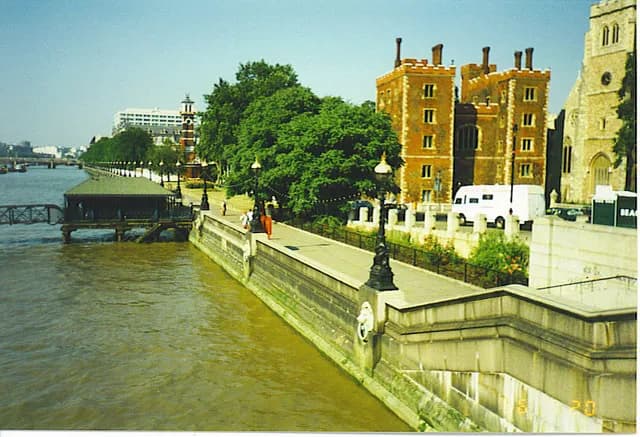
Lambeth Palace has stood on the south bank of the Thames for over 800 years as the official London residence of the Archbishop of Canterbury. The Grade I listed complex sits just 400 yards from the Houses of Parliament, bridging spiritual and constitutional authority in the heart of Lambeth.
Origins and Early History
The estate was acquired by the archbishopric around AD 1200, though Archbishop Anselm had already established a house on the site a century earlier. The location was strategically chosen for its proximity to the royal palace and government seat at Westminster, just across the river. The name "Lambeth" derives from the Old English "Lambehitha," meaning "landing place for lambs," first recorded in 1062.
The oldest surviving part of the palace is the Chapel, built around 1230 in Early English Gothic style. This makes it one of the earliest Gothic structures in England. The chapel was severely damaged during the Blitz in 1941 and underwent extensive restoration between 1954 and 1988.
Architecture Through the Ages
Morton's Tower, the massive five-storey brick gatehouse visible from Lambeth Road, was completed in 1495 under Cardinal John Morton. The tower originally housed eight lodgings for the Archbishop's household and remains one of the most distinctive features of the Lambeth skyline.
The Lollards' Tower, built between 1434 and 1435 from Kentish ragstone, served as a water tower and reportedly contained a prison for religious dissenters at its summit. The Great Hall was rebuilt in 1663 by Archbishop William Juxon following its destruction during the English Civil War, featuring a late Gothic hammerbeam roof that Samuel Pepys described as "a new old-fashioned hall."
Between 1829 and 1834, architect Edward Blore added a major neo-Gothic wing to the east side of the palace, creating much of the exterior visitors see today. The site also contains a rare cloister; Archbishop Hubert Walter had initially intended to found a Premonstratensian abbey on the grounds.
Turbulent Centuries
Lambeth Palace has witnessed many pivotal moments in English history. In 1378, theologian John Wycliffe was tried for heresy within its walls. The palace came under attack during the Peasants' Revolt in 1381. In May 1640, popular discontent with Archbishop William Laud's theological reforms led to another assault on the building.
The English Civil War brought the palace's darkest period. Parliamentarians ransacked and partially demolished the complex in the 1640s, dismantling the Great Hall and selling its materials. Following the Restoration of the monarchy in 1660, Archbishop Juxon oversaw a major reconstruction programme that returned the palace to working order.
Cardinal Reginald Pole, the last Catholic Archbishop of Canterbury, died at the palace in 1558 and lay in state there for 40 days. The Blitz in 1941 inflicted further damage when incendiary bombs struck the Great Hall, destroying or damaging approximately 10,000 books from the library collection.
A Working Palace in Modern Lambeth
Today Lambeth Palace remains an active residence and office, not merely a heritage site. The current Archbishop, Justin Welby, uses it as his London base whilst maintaining a secondary residence at the Old Palace in Canterbury. The Archbishop serves as an ex officio member of the House of Lords and is regarded as "first among equals" in the worldwide Anglican Communion.
The palace grounds contain what is believed to be London's oldest continuously cultivated garden, dating from the 12th century and listed Grade II. The site also gave its name to Archbishop's Park, formerly the palace orchard until the early 19th century, now a public park enjoyed by Lambeth residents.
St Mary-at-Lambeth, the church adjacent to the palace with a tower dating from 1377, was deconsecrated in 1972 and now houses the Garden Museum. During renovation work in 2017, builders discovered a hidden crypt containing 30 coffins, including five Archbishops of Canterbury. The Garden Museum now maintains this connection to the Tradescant family of gardeners, whose tomb remains on the site.
The Community of Saint Anselm, an Anglican religious order under the Archbishop's patronage, is also based at Lambeth Palace, continuing the site's spiritual mission.
The Lambeth Palace Library
The library, founded by Archbishop Bancroft in 1610, houses the archives of the Archbishops dating back to the 12th century and holds over 120,000 printed books. In 2021, a new purpose-built library designed by Wright & Wright Architects opened to the public, the first new building on the site in 185 years.
The new library features 300,000 handmade bricks, over 20,000 linear metres of shelving, and 5,400 square metres of floor space, achieving a BREEAM "Excellent" sustainability rating. A public entrance on Lambeth Palace Road now provides direct community access. The Reading Room is open Monday, Wednesday, and Friday from 10:00 to 17:00, Tuesday from 11:00 to 17:00, and Thursday from 10:00 to 19:15, though registration at least two working days in advance is required.
Recent Restoration and Environmental Leadership
Between 2022 and 2025, Lambeth Palace underwent its first major refurbishment in over 70 years. The £25 million project transformed the medieval complex into a model of sustainable heritage retrofit, cutting carbon dioxide emissions from 647,000 kg to 233,000 kg annually—a reduction of 64 per cent.
The refurbishment included a new Energy Centre with three air-source heat pumps, replacing gas heating throughout the complex. Engineers installed 2 kilometres of underground insulated heating pipes and replaced over 160 single-glazed windows with double-glazed sash windows. Solar panels were installed discreetly on the roof, rainwater harvesting systems were implemented for toilet flushing, and 39 tonnes of timber were recycled during construction.
The project also delivered significant accessibility improvements, including step-free access, lifts throughout the building, and 26 new toilets with DDA-compliant and Changing Places facilities. Heritage preservation work included replacing 1,450 square metres of floorboards, restoring 800 square metres of stonework, and replastering and painting 13,500 square metres of interior surfaces.
Archaeological investigations during the refurbishment proved remarkably fruitful, uncovering more than 240 historic wall segments from the 11th to 19th centuries. Finds included medieval decorative fragments and a tiled cloister floor that may have been walked upon by Henry VIII and Elizabeth I—the most comprehensive archaeological investigation ever conducted at the palace.
Visiting Lambeth Palace
The palace opens to the public through guided tours on selected days throughout the year. Visitors can explore the historic Chapel, the Great Hall with its distinctive hammerbeam roof, and the gardens that have been cultivated for nearly nine centuries. Garden tours are scheduled for June and July 2026.
The Great Hall and other event spaces are available for hire with catering provided. Concerts are regularly held in the Great Hall featuring St Martin's Voices. The Garden Museum next door hosts an annual Neighbours Day, further connecting the palace to the local community.
For Lambeth residents, the palace represents both an extraordinary historical asset and a continuing presence in borough life. From Archbishop's Park to the newly accessible library, from the Community of Saint Anselm to the Garden Museum, this ancient institution remains woven into the fabric of modern Lambeth.